
Before you send
Packaging guide
Good packaging is the best guarantee that your shipment will arrive intact. Here is how to prepare any parcel for the GLS network —box, filling, fragile items and label—, the weight and size limits, and the list of parcels that cannot be processed on conveyor belts and need special handling.
Official packaging guide in PDF to read or print.
How to pack your parcel
Rigid double-wall box
Use a double-wall corrugated cardboard box in good condition, sized to fit the contents. A box that is too large lets the contents move; one too small may give way or open. Remove labels and barcodes from previous shipments.
Fill the gaps
Leave no empty spaces: fill with bubble wrap, foam or crumpled newspaper so the contents do not move inside the box. The whole thing should feel firm when shaken. Seal with strong packing tape in an H-pattern (flaps and edges).
Protect fragile items
Wrap each fragile item separately in bubble wrap and keep it away from the others and from the box walls with cushioning material. If you ship liquids, use a leak-proof container and place it in a sealed bag inside the box.
Apply the label correctly
Print the label at full size (100%, without scaling) and affix it to the largest, flattest face of the parcel, visible and without creases or folds. Do not cover the barcode; if you can, protect it with clear tape. The label is the only thing that identifies your shipment on the network.
Weight and size limits
- Domestic (BusinessParcel/EconomyParcel/Express): maximum 30 kg actual weight per parcel and girth (length + 2×width + 2×height) ≤ 300 cm.
- EuroBusinessParcel (within the EU): maximum 40 kg per parcel (34.5 kg in Romania) and girth ≤ 300 cm; volumetric weight = length × width × height ÷ 6000.
- ParcelShop / OOH (pick-up point delivery): maximum 20 kg per parcel and sum of the 3 dimensions (length + width + height) ≤ 150 cm.
- Chargeable weight is the greater of actual and volumetric weight: volumetric weight only affects the price, it never prevents the shipment.
- Parcels exceeding these limits will be refused at collection or will require special packaging or service.
Parcels NOT suitable for conveyor belts
The GLS network sorts parcels on automatic conveyor belts. These 12 types of parcel cannot be processed that way and require special packaging or handling; bring your case to the agency and we will tell you how to send it.
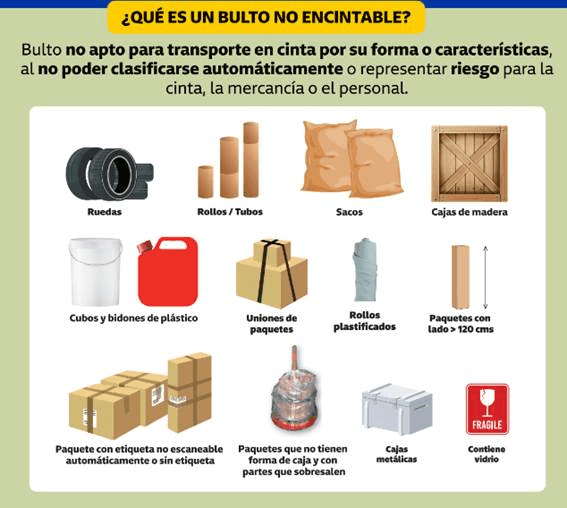
Loose wheels and tyres
Wheels, tyres or rims without a box that holds them in place; they roll and jam the belt.
Rolls and tubes
Long rolls of material or tubes that cannot rest flat and slide along the belt.
Sacks and flexible bags
Sacks or bags with no rigid structure; they cannot be sorted or stacked safely.
Unprotected wooden boxes
Wooden boxes with edges or protrusions that may catch on or damage other shipments.
Drums and cylindrical containers
Drums or cylinders that roll along the belt and will not stay in position.
Several parcels strapped together
Parcels joined with tape or cable ties but not integrated into one rigid parcel; they separate during sorting.
Plastic-wrapped or film rolls
Rolls wrapped in slippery film that the belt cannot grip and slide off.
Any side over 120 cm
Parcels with a side over 120 cm without special packaging; they do not fit on the belt or the shelves.
No scannable label surface
Parcels without a flat, smooth face where the label can be read by the scanner.
Protruding parts
Handles, sticks, rods or protrusions that stick out from the body of the parcel and may catch.
Metal boxes and containers
Metal boxes or cages that damage the belt or other shipments during sorting.
Glass without rigid protection
Glass without rigid protection that isolates it and prevents breakage and damage to others.
Your most frequent cases
Two shipments we prepare almost every day in Mazarrón that touch several of the categories above at once. Here is how to make them belt-ready:
Bicycle with the wheels removed
A compact bike box (≤ 30 kg and girth ≤ 300 cm) DOES go on the belt. What rules it out is what sticks out: loose wheels outside the box, handlebar or pedals exposed. Fix it: remove the pedals, turn the handlebar parallel to the frame and secure the wheels INSIDE the box with cable ties or foam, filling the gaps. That makes it a regular rigid parcel, not an irregular one. The e-bike battery does not travel (it is dangerous goods).
Suitcase with fragile contents
The suitcase DOES go on the belt if you lock the zips with a padlock or cable tie, secure or tuck away handles and straps so nothing sticks out and, if it is soft, wrap it in film. Fragile items do not travel loose inside: wrap each one separately in bubble wrap and pack it between clothing or filler so it cannot move. A well-closed suitcase with no handles sticking out is a normal parcel; what makes it irregular are the parts that catch.
If your shipment falls into one of these cases, it does not mean it cannot be sent: it means it must be prepared specially (extra box, strapping, edge protection). Come by the agency or write to us and we will help you get it ready.
Unsure about your packaging?
Come by the Mazarrón agency with your parcel and we will help you get it ready for the network, or write to us and we will tell you how to prepare it. And once it is ready, quote your shipment in one click.